
Huntington County Traffic Warrants Explained
Miss a court date, skip a payment, or leave a requirement unfinished, and a traffic warrant can follow in Huntington County. Traffic and criminal violation records run through the Huntington County Clerk and the current Circuit and Superior Courts, and the county posts no separate municipal court or public traffic-warrant roster. Indiana courts say "warrant for failure to appear," or FTA, rather than capias, so search with that phrase in mind. The docket and the judge control the real effect. A late ticket alone does not mean a warrant exists. An online balance alone does not mean one is absent either, so confirm with the court before assuming either way in Huntington County.
A Missed Huntington Traffic Date
When an appearance date slips by, hold onto the ticket and pull its cause or UTT number. Search the Huntington County court file with that identifier. Then ask the Clerk directly whether the record shows an FTA, a warrant, a required appearance, a balance, or another compliance step. Do all of that before any payment portal.
- Read the ticket for its appearance date and issuing agency.
- Search MyCase by citation or cause number.
- Record the court code and public docket wording.
- Call the Clerk at (260) 358-4817 and verify current status.
- Follow the court's payment, appearance, or filing instruction.
Key Point: Paying a displayed base amount does not necessarily recall a traffic warrant or excuse an appearance.
Checking for a Traffic Warrant
Each channel plays a different role. MyCase can surface a public warrant-related event, but it is no all-warrants database. The County Clerk handles traffic and criminal violations and can explain court procedure. Circuit Court sits at (260) 358-4814 and Superior Court at (260) 358-4852. The Sheriff main line, (260) 356-2520, and non-emergency dispatch, (260) 356-8316, route law-enforcement questions but run no warrant desk. For custody and bond, call the 24-hour jail at (260) 356-3110. County APRA requests reach public county or agency records, while court files belong to the Clerk.
Inside a Huntington Traffic Warrant Record
Identifiers must match across the case record, ticket, and payment tool. A Huntington cause number can look like 35D01-2501-IF-000123. That sample shows format only; it is no one's real case.
| Cause number | County, court, filing segment, case type, and sequence. |
|---|---|
| UTT or citation | The ticket identifier used in search and payment routing. |
| Issuing agency | The law-enforcement body that wrote the citation. |
| Appearance date | The deadline to pay or appear, as the case permits. |
| FTA event | A public docket entry concerning failure to appear. |
| Balance | A court amount that should be verified with the Clerk. |
An open Huntington County case does not guarantee a warrant. A closed label skips the history. Get the exact warrant wording and its current status from the court.
The Huntington Bridge Payment Portal
The Clerk's traffic page links an official payment vendor. The Bridge form asks for a cause number or UTT number, the driver's name on the ticket, and optional comments, and it tells the payer to confirm the amount through MyCase. The listed service surcharge is 3.5 percent with a 50-cent minimum, so verify that figure live before paying. The official portal shows those payment fields on its page.
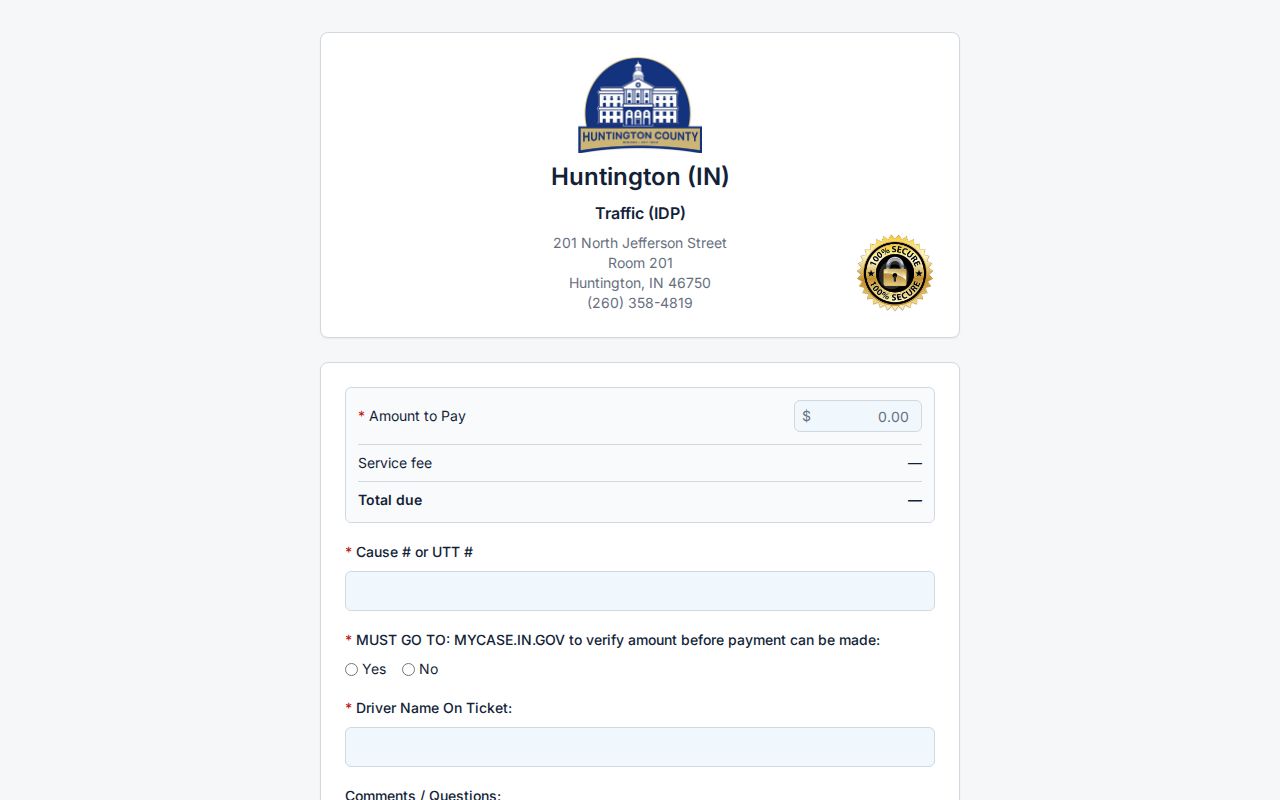
Huntington County readers should note the portal is a payment tool, not a warrant lookup or a court recall order.
How to Pay or Lift a Traffic Warrant
Huntington County accepts three routes: the official Bridge portal, card payment by phone through the Clerk, and mail to Traffic Tickets, P.O. Box 228, Huntington, Indiana 46750. The Clerk page lists fax (260) 358-4880 and bars personal checks. Include the ticket or ticket number and the name on it. Some violations require an appearance rather than simple payment. The January 2025 schedule put speeding 1 to 15 mph over at $140, 16 to 25 at $150, and 26 or more at $175, with construction-zone cases adding $300. Those are dated fee examples, not warrant amounts, so confirm the exact balance and any appearance requirement with the Huntington County court.
Warning: Only the issuing court can confirm that compliance recalled the warrant and released any related court report.
Huntington Traffic Deferral Is Conditional
The Huntington County Traffic Infraction Deferral program runs six- and twelve-month tracks for eligible citations, with restrictions tied to recent convictions, points, prior use, and commercial-driver status. Deferral questions go to (260) 358-4846. It is not amnesty, and it does not auto-recall a warrant. Where a warrant or FTA exists, clear that status first, then ask whether deferral is still open. Ticket class alone tells you nothing about eligibility; the prosecutor and the court decide admission and completion.
Traffic Warrants, FTA, and License Holds
Miss a court date or skip a payment in Huntington County, and the court can report that failure to the Indiana Bureau of Motor Vehicles. The BMV can then suspend driving privileges. The BMV traffic-violation guidance explains that consequence, though a license issue alone tells you nothing about an active Huntington County warrant.
| Record | Custodian | Purpose |
|---|---|---|
| Traffic case | Clerk and court | Citation, FTA, warrant, payment, compliance |
| BMV report | BMV | License consequence from court reporting |
| Payment record | Clerk or official vendor | Transaction, not automatic recall proof |
Clear the Huntington County court issue first. Once the court sends its notice, follow the BMV reinstatement guidance to restore driving privileges. A reinstatement fee may apply.
Request Huntington Traffic Court Records
The Huntington County Clerk can pull court documents by cause number or citation number. For a law-enforcement or administrative record, Huntington County offers an online, printable, or in-person APRA route. Name the department, the date, the record type, and whether you want to inspect or copy it. The form's 24-hour disclosability notice is just a notice. It is not a production deadline. The judicial file follows the Indiana Access to Court Records Rules, so sealed or excluded material stays sealed no matter how broad the APRA demand is. The county publishes no general copy fee schedule, so ask about costs before the office processes your request.
Huntington Traffic Warrant Terms
These labels keep each part of the court process distinct.
- FTA
- Failure to appear for a required court date.
- UTT
- The citation number used to locate or pay a ticket.
- Recall
- A court action withdrawing an outstanding warrant.
- Cause number
- The unique identifier for the court case.
- Must appear
- A case that cannot be resolved by simply sending the listed base payment.
Ask the Huntington County Clerk which term the current docket actually uses. A vendor payment label is not a judicial ruling.
Huntington Traffic Payment Checks
Work payment questions through the court record, not around it. MyCase and the ticket should match. When the two show different amounts, stop paying and ask the Huntington County Clerk which figure is current. Guessing at a stale fee invites a bigger mess. The same goes for third-party sites, which have no role in a Huntington County traffic warrant check. The official Bridge form itself tells users to check MyCase before paying, and the Clerk remains the source for the balance and for whether a case can be paid without appearing. Once you pay, keep the receipt, the transaction reference, and a copy of the ticket. Then look at the record again or call the Clerk to confirm the payment posted and to learn whether any FTA or warrant event needs separate court action. An approval from the card processor only shows a transaction occurred. It cannot tell you a judge recalled a warrant, canceled an appearance, or that the BMV got a compliance notice. If the court requires appearance, ask for the date, the room, and the identification and filing instructions. Bring the citation and each receipt so staff can match the right file. Clerk staff in Huntington County can explain the process. They cannot recommend a plea or predict the judge. Legal advice should come from an Indiana attorney.