
Huntington County's Most Wanted Program
Huntington County publishes no Sheriff most-wanted page and no public warrant roster. No roundup calendar appears either. No warrant tip line does. A missing page proves little, since a wanted person or special event can exist without one. The Sheriff's official page offers general law-enforcement contacts but no public list of warrants, so any warrant question goes through the office itself. What follows links only official sources. No names, photos, or mugshots appear here.
Key Point: Huntington County has no verified local most-wanted list to reproduce or treat as a full active-warrant index.
What Huntington Most Wanted Is Not
A most-wanted list never catalogs every warrant. The agency picks a handful of people for attention based on its own priorities, and even where a list runs, most active warrants never show up on it. A missing name proves nothing. Huntington County's own channels have narrow jobs. MyCase is a public court-case portal, not a statewide warrant database. The Sheriff's $10 local criminal-history check covers limited arrest or booking history, not full case outcomes or warrant status. The jail line takes custody and bond questions. A tax warrant, meanwhile, is an Indiana DOR lien or judgment rather than an arrest warrant.
How the Most Wanted Lists Work
Ordinarily an agency chooses which unresolved warrants to feature. It publishes a short notice. Then it updates the page after an arrest, a surrender, a recall, or a shift in priorities. Huntington County documents no such local process in public. No selection rule, refresh schedule, reward policy, removal procedure, or public roster exists on any county channel. The Andrews Police page links out to Indiana's Most Wanted. That link is statewide, and it does not make Andrews Police or Huntington County the keeper of the state list. Follow the official link itself. Verify which agency issued any notice, because a published list can lag real events and only the agency or issuing court knows current status.
Statewide Links Are Not Huntington Lists
An Indiana label can look local when it is not. Andrews offers a handy route to a statewide resource, but nothing official says every Huntington County warrant feeds into it. Indiana Judicial Branch guidance is blunt on this point. No public website searches all arrest warrants across the state.
| Source | Geographic scope | Correct use |
|---|---|---|
| Huntington Sheriff | County law enforcement | General routing, not an online roster |
| Indiana's Most Wanted link | Statewide program | Read the official state notices only |
| MyCase | Participating Indiana courts | Locate a public case and court |
| U.S. Marshals | Federal district and national work | Federal fugitive information and tips |
Do not stitch these sources into a homemade Huntington County most wanted list. Their scopes, update rules, and custodians all differ.
Reporting a Tip Safely
Use the channel the official notice names. Huntington County's non-emergency dispatch is (260) 356-8316, and the Sheriff main office is (260) 356-2520; neither works as an anonymous reward line. Call 911 only for an immediate threat.
- Read the official agency notice and identify its stated tip channel.
- Report the location, time, and conduct observed without pursuing the person.
- Do not post private information or repeat an unverified accusation online.
- Keep any reference number the official program provides.
- Step away and let trained law enforcement assess the information.
Key Point: Never approach, follow, restrain, or try to arrest a person based on a wanted notice.
Federal Fugitive Work Is Separate
Federal fugitive work runs on its own track. The U.S. Marshals Service Northern District of Indiana page lists a 24-hour federal tip channel. Huntington County sits inside that district. A federal profile is still not a county warrant record. Use the U.S. Marshals district page for a federal notice or tip only; the official federal court-location source places Huntington County in the Fort Wayne division.
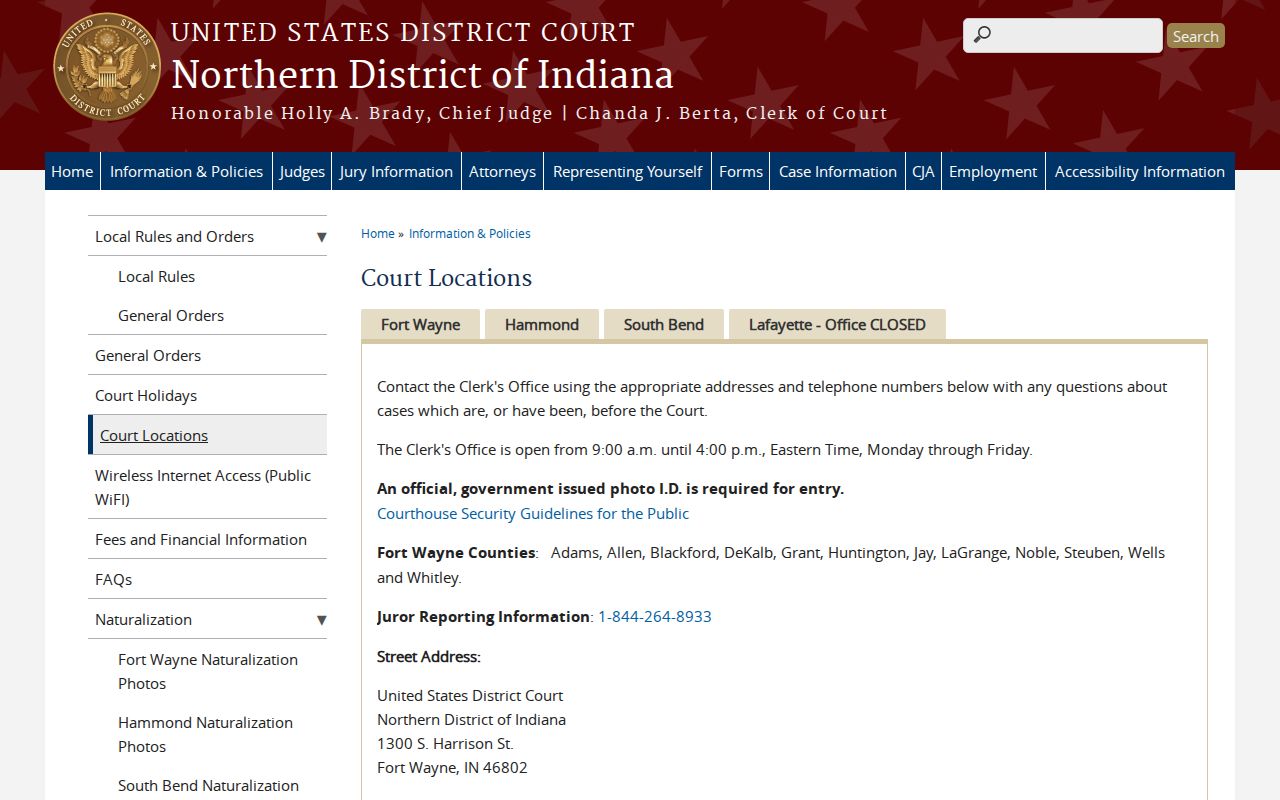
A federal case belongs with the Northern District Clerk. So does PACER, not a Huntington County or state list. The federal Clerk's Office is at 1300 S Harrison Street, Fort Wayne, Indiana 46802. Its number is (260) 423-3000. The court also warns that it never calls or emails to collect money or personal information about arrest warrants.
Most Wanted Lists vs Active Warrants
A most-wanted notice is a publicized subset. An active warrant stays in force until served. Huntington County publishes no official list for either, so an empty search is not legal clearance.
| Feature | Most-wanted notice | Active warrant |
|---|---|---|
| Scope | Selected priority cases | Any current unserved warrant |
| Publication | Agency chooses whether to feature | May appear only in a court file |
| Update | Agency schedule, sometimes delayed | Changes through court or service action |
| Huntington source | No county page located | No county roster located |
| Verification | Publishing agency | Clerk and issuing court |
Suspect a local warrant? Search MyCase, save the cause number, then ask the Huntington County Clerk or issuing court for the current status.
No Huntington Amnesty Event Found
No office in Huntington County runs a warrant roundup, amnesty day, safe-surrender event, reward schedule, or special recall program. That gap invites wishful thinking. No past or unofficial post grants immunity, a fee waiver, payment-only resolution, no-arrest treatment, or same-day recall. If the county later announces a program, confirm its dates, eligibility, location, participating agencies, payment rules, and exclusions on the live government source. An expired announcement creates no present rights. Until then, identify the case and follow court-approved compliance.
Checking Huntington Warrant Status
Start with the court record, not a most-wanted search. That holds whether you are checking your own status or helping a relative. MyCase may surface a warrant-related event in a public case summary, but older, sealed, confidential, expunged, or unavailable cases may not appear. A common name also breeds false matches.
- Search by exact cause number, citation number, or party.
- Narrow party results by Huntington County, court, and filing date.
- Identify code 35C01 for Circuit or 35D01 for Superior Court.
- Call the Clerk at (260) 358-4817 and verify the live number.
- Ask whether the current record shows an unresolved warrant and what court handles it.
The Sheriff's office is at 332 E State Street. It routes law-enforcement questions, while the jail at (260) 356-3110 handles custody and bond around the clock rather than public warrant clearance.
Huntington Most Wanted Records Requests
Want a paper trail behind a most-wanted posting in Huntington County? The county runs APRA request channels that reach any existing nonsealed law-enforcement record: an online form, a printable form, or a walk-in request at the Commissioners' Office. Say which department holds the file, give the date, and name the exact record you want. Ask about fees before you submit. The form promises a 24-hour disclosability notice, but that only tells you whether the record can be released. It is not a promise of same-day production. Court records run through the County Clerk instead, under Indiana's court-access rules. Rule 5 keeps investigative files, sealed affidavits, and protected data out of most releases. Rule 9 offers a slower path: a verified written request and a ruling from a judge in the right case. One limit worth knowing. Public-record law does not force any Huntington County agency to build a most-wanted list that does not exist.
If You Think You Are on a List
A web post alone is a bad reason to walk into a sheriff's office, and a phone caller demanding money to clear a warrant is almost surely a scam. Save the official link. Note which agency it names. Then let an Indiana attorney verify the matter with the issuing court before you act. Counsel can ask about bond, a scheduled appearance, a motion, or voluntary surrender. No lawyer can promise an outcome, though. Huntington County's jail page lays out the release categories: cash, 10 percent cash, surety, split, and court-ordered own-recognizance. Those are labels for what a judge may allow, not a guarantee of release. The judge and the posture of the case control what happens next.
Important: Confirm through counsel and the issuing court; never rely on a copied roster, unsolicited payment demand, or social-media rumor.